
How to Choose the Right Pop-Up Gazebo for Your Event or Business
Buying a pop-up gazebo sounds simple until you’re faced with dozens of models, frame types, and fabric grades all claiming to be “heavy duty.” The right choice depends on how you’ll actually use it, how often, and in what conditions. This guide breaks the decision down into four simple steps so you can buy with confidence the first time.
Who Actually Needs a Heavy Duty Pop Up Gazebo?
Not every gazebo needs to be commercial-grade, but many buyers underestimate what they need. Heavy-duty pop-up gazebos are the preferred option for:
- Market traders who set up and take down several times a week and need a frame that survives constant use
- Garden parties and family events where you want something sturdy enough to trust with guests, food, and furniture underneath
- Sports clubs and event organisers who need shelter that can handle a full day outdoors, rain or sun
- Trade shows and exhibitions where the gazebo doubles as a branded space, not just shelter
If you’re only using a gazebo once or twice a year for light garden use, a basic frame might do. But for anything regular, outdoor commercial, or exposed to wind, it’s worth paying for a proper heavy-duty frame, because the difference shows up the first time a gust of wind hits a cheap one.
Step 1: Decide on Frame Strength
This is the single biggest factor in gazebo quality, and it’s where most of the price difference comes from. Frame strength generally comes down to four tiers:
- Premium 32 is a steel square-section frame. Strong, reliable, and the most budget-friendly of the heavy-duty range, it’s a solid all-rounder for regular outdoor use.
- Premium Hex 40 is also steel, but with an upgraded 40mm hex-shaped frame for extra rigidity. It’s a good step up if you want more stability without moving to aluminium.
- Premium Plus 40 is the first aluminium range, with a 40mm hex leg and reinforced overhead cross sections. It’s lighter to carry and set up, which matters if you’re transporting it often, and it’s popular with commercial users who move their gazebo between sites.
- Deluxe 50 is the toughest option, with ultra-reinforced 50mm hex legs built to handle the most demanding weather conditions. If you need maximum durability and don’t mind the extra weight, this is the one.
As a rule of thumb, steel frames (Premium 32, Hex 40) offer the best value for stationary or occasional commercial use, while aluminium (Premium Plus 40) suits anyone prioritising portability. Deluxe 50 is worth the investment if you’re using the gazebo in exposed or unstable conditions.
Step 2: Pick the Right Fabric Grade
Frame strength gets most of the attention, but the canopy fabric matters just as much for weatherproofing and longevity.
- 800D Oxford + PVC is used on Premium 32 and Hex 40. It’s a dense, waterproof double-layer fabric that holds up well to regular outdoor use and UV exposure.
- Premium Plus 40 uses 300G fire-retardant polyester + PVC. It adds a fire-retardant layer, which matters for commercial and public events where fire safety compliance is often required.
- Deluxe 50 uses 450G fire-retardant + ultra-thick PVC. It’s the heaviest, most protective fabric grade, built to match the frame’s durability.
If you’re setting up at markets, fairs, or any public event, check whether the venue requires fire-retardant certification. It’s a common condition that’s easy to overlook until you’re turned away on the day.
Step 3: Think About Size
Size depends on how much space you need to cover and how many people or tables have to fit underneath. As a general guide, 3m x 3m suits most single-stall or small garden setups, while 3m x 4.5m and 3m x 6m give you room for multiple tables or a larger gathering. If you’re between sizes, it’s almost always better to size up, since a slightly larger gazebo gives you flexibility that a slightly smaller one can’t.
Step 4: Don’t Forget the Extras
A gazebo on its own is only part of the setup. A few extras are worth planning for from the start rather than adding later:
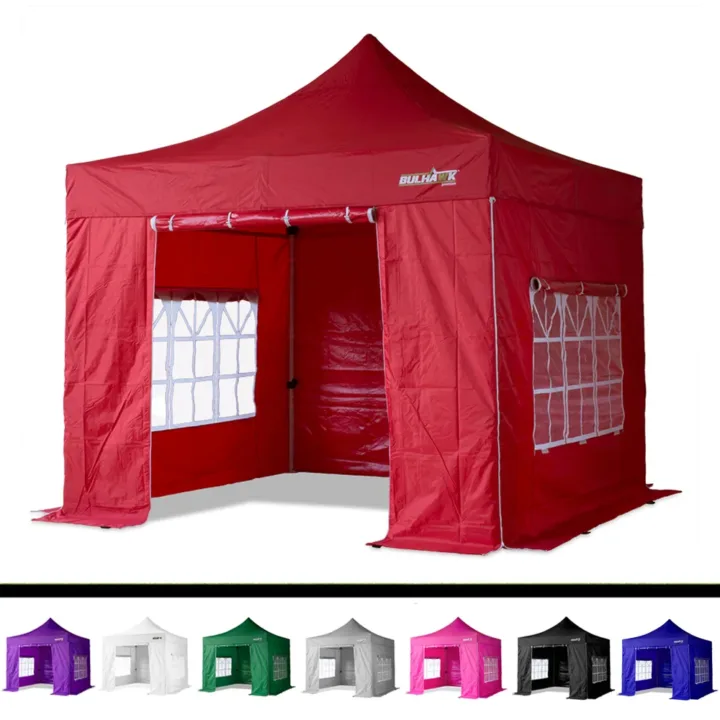
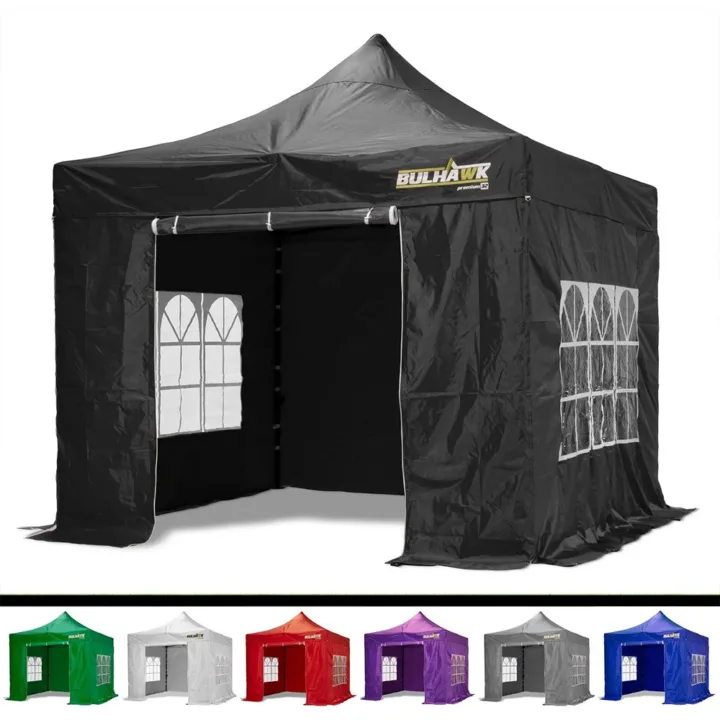
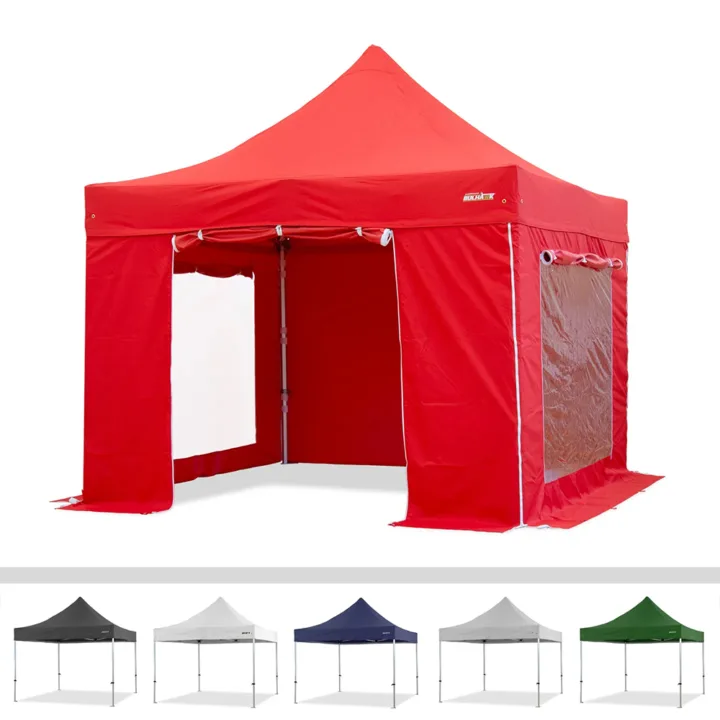
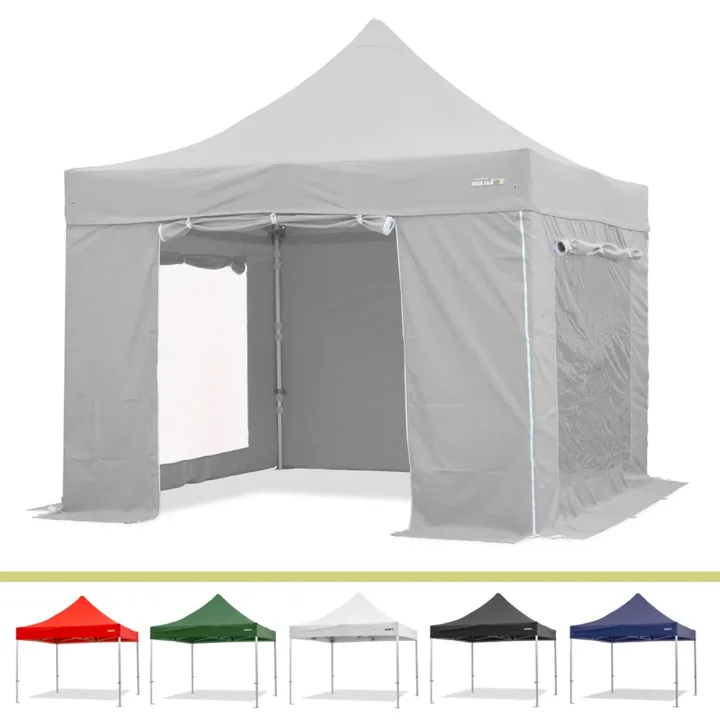
- Half wall kits for extra wind and privacy protection along the lower half of the gazebo, especially useful for market stalls or events running into the evening
- Leg weights to keep the frame secure in windy conditions, which is mandatory for any outdoor commercial use
- Custom printing if you’re using the gazebo for business branding at markets, fairs, or sponsored events
These add-ons are inexpensive relative to the gazebo itself but make a real difference to how usable and safe it is once set up.
Bulhawk Model Comparison Table
Model | Frame | Fabric | Best For |
Steel, square-section | 800D Oxford + PVC | Regular use, best value | |
Steel, 40mm hex | 800D Oxford + PVC | Extra stability, still steel-budget | |
Aluminium, 40mm hex | 300G fire-retardant + PVC | Portability, commercial/fire-compliant use | |
Aluminium, 50mm hex | 450G fire-retardant + PVC | Maximum durability, demanding weather |
FAQ
How easy is it to set up a heavy-duty pop-up gazebo?
Very easy. The pop-up frame design means you don’t need any tools. Open the frame, attach the canopy, secure the legs, and it’s ready in minutes.
What sizes are available?
Sizes range from compact 2.5m x 2.5m gazebos up to large 6m x 3m models, depending on the range.
Do Bulhawk gazebos come with a warranty?
Yes, all models come with a minimum 1-year warranty against manufacturing defects. Check the individual product listing for full details.
Can I add sidewalls later if I don’t need them right away?
Yes, you can add or remove sidewalls as needed, and they aren’t required at purchase.


